Thursday, October 4, 2012

Can You Overcome Gravity?

Today, our young scientists were busy at work in their laboratory. They were seeking the answer to their essential question, How can the pull of gravity be overcome?  They were given a hairdryer, three ping pong balls, and a cotton ball. Their task was to set the hair dryer on cool, point it toward the ceiling, and then carefully put a ping pong ball in the stream of air. 

They concluded that the force of air was stronger than the pull of gravity so the ping pong ball floated in the air stream. Then, they turned the hair dryer slightly to the left and slightly to the right, and noticed that the ping pong ball would follow the air stream and stay suspended, unless, like one group discovered, the stream of air was not strong enough. In that case, the pull of gravity would be stronger and the ping pong ball would be pulled toward Earth.
 
Next, the young scientists tried floating two or more ping pong balls in the air stream. Some groups were successful while others were not. The discussion behind the mixed results provided an excellent way to introduced the independent variables (What changed?), dependent variables (What did not change?), and constants in this hands on lab. 

In addition, the students discovered that floating the cotton ball had a different result. In their exploration, they also discovered that the cotton ball would stick to the bottom of the hairdryer and stop the flow of air. When this occurred, the forced air would be weaker than the pull of gravity.

In our analysis of the lab,students quickly made the connection that the air stream was stronger than the pull of gravity on the mass of the ping pong ball. We asked, "What do you think would happen if we tried the same thing with a golf ball or even a basketball?"  Students concluded that the mass of the golf ball and basketball would be too much for the air stream and gravity would pull it to the ground. However, they also recognized that with a great enough force, they would be able to get the golf ball and basketball to levitate. Some students thought that a leaf blower would work to levitate heavier objects. 

In Closing, one student shared that he once was in a machine that made him levitate!  He's bringing a video of the experience in for the class to see. How exciting! 

Today's lab explored Bernoulli's Principle, the principle that allows heavier-than-air objects like airplanes to fly. Bernoulli discovered that the faster air flows over an object, the less the air pushes on the surface of the object and so the lower the pressure. In this lab, gravity is pulling on the ball while the pressure from the forced air pushes up on the ball. The forces are balanced,so the ball hovers in the air. You can move the hair dryer from side to side, and the ball will stay hovering in mid-air until one of the forces is stronger than the other. 

The students loved the lab and the learning was evident. We hope your young scientist shared their enthusiasm. Furthermore, if you are a student reading this post, we'd love it if you leave us a comment and tell us what you liked most about today's gravity lab.


Tuesday, October 2, 2012

Subtraction Strategies

Thinking flexibly about numbers is one of our goals for students in third grade. Throughout our MI Unit 3, Addition, Subtraction, and the Number System, we’ve been highlighting multiple strategies in Closing Session as we teach students that subtraction is the distance between two numbers. We do this to highlight students' use of an efficient strategies, and as a springboard to challenge students to attempt a strategy that they may not have mastered.  Students quickly realize that some of the strategies are more efficient for particular situations and less prone to computational errors.

Students, as we conclude our subtraction unit,  should be comfortable with multiple subtraction strategies. Solving a problem in using two strategies prevents a computational error that may have been overlooked. Our goal is to have students who can recognize, based on the situation, the most efficient strategy with the least likelihood of error, and with the idea that mental math can be one of the most effective ways to solve.  

For example, we don’t want students to use the traditional algorithm to solve an equation like 1000-989=m, because it would be easy for them to make a computational error when regrouping multiple times. Rather, we want students to recognize that the distance between these two numbers can easily be done by counting up, 989+1=990 and 990+10=1000,therefore, the difference is 11. 

Of course, in other situations, it's simply easier to solve using the traditional algorithm. In 876-563, the quickest way to the difference is simply using the traditional algorithm. 

In order to develop number flexibility, we’ve been working on several strategies in class.
 
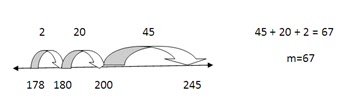
Sample Problem:  245 - 178 = m
Adding up
Turn the equation into a missing addend 178 + m = 245. Put the number 178 on a number line and count up to the next landmark number. (Landmark numbers have a O or 5 in the ones place.) 178 count up 2 to 180, count up 20 to 200, and then jump 45 from 200 to 245. Adding the jumps gives you the answer, m = 67.

Decomposing
Decompose the number by place value, then subtract each place value. In this problem, 200-100 = 100, 40-70 = -30, 5-8 = -3, therefore 100-30-3= 67.  Sometimes, this strategy has you in negative numbers, but students know that 0 is the middle of the number system and can flexibly use negative numbers. Some students use this strategy and regroup from the larger place value. If they did that in this problem, they would take a group of 100 from 200 and put 140 in the tens place.

            245  :     200    40    5
          -178  :    -100  +   70  +   8
                            100   - 30  - 3 = 67

Counting backward
245 - 178 = m                                                                    

Put 245 on the open number line and count backward 178. You can make the jump of 178 any way you want. Most kids jump backward to landmark numbers. 245 jump back 45 is 100, and then jump back 30 is 70, then jump back 3 is 67. This strategy works best for students who can readily count backward, other students find it difficult.
Left to Right 
Students think 200 – 100 = 100 and 40 – 70 = -30 and 5 – 8 = -3.  Then, 100-30 is 70, and 70-3 is 67.
            245  :    
          -178  :   
            100 – 30 – 3
                70 – 3 = 67

 
 Compensation / Creating an Equivalent Problem
 
In some situations, we also encourage students to compensate to create an easier equivalent problem. Generally, in subtraction, when you create an equivalent problem your goal is to create a problem where regrouping is not necessary. Many students try to create the digit 9 in their minuend.

For example,
  56   + 3        59
-47     -3       -44
                        15

Remember, the purpose of exposing students to multiple strategies is two-fold. First, students need to be able to solve using two different strategies to check their work, and secondly students will be able to identify the strategy that is most efficient based on the problem. Students who successfully accomplish this have number sense and are able to work with numbers mentally and flexibly. Our students are busy every day becoming young mathematicians.

Addition Strategies

From time to time, we have students complete math portfolio pieces to show evidence of students' understanding of a concept or skill. Recently, students completed an addition strategy piece. 

The portfolio piece had two problems, 298+574, and a word problem, Mrs. Shall has 321 shells in her seashell collection. Miss Russell has 524 shells in her seashell collection. How many seashells do Mrs. Shall and Miss Russell have if they combine their collections?

Students used two different strategies to solve. Research shows that when students make a computational error and use the same strategy the second time they solve, they commonly make the same mistake. In addition, students with a tool box of strategies are better able to approach each problem and use the strategy that is most efficient for the given problem. 

In some situations, the most efficient strategy is the traditional algorithm, but in others, to use more mental math, it may be compensation or left to right addition. 


This is a student's sample from our Addition Portfolio Piece. You'll notice that the student used two different strategies to solve 298+574, decomposing by place value and left to right addition.

Decomposing By Place Value
298+574
(200+500) + (90+70) + (8+4)
      700        +    160      +   12     =   872

Decomposing by place value is a strategy used by many mathematicians for mental math. The strategy keeps the place value of the numbers, and gives students the opportunity to solve for partial sums by place value.  The strategy, in this situation, avoided the traditional regrouping between place values. You can see the student's understanding of correct algebraic notation, too.

Left to Right Addition
     298
   +574
     700
+  160 
       12
    872

Like decomposing, left to right is a strategy that lends itself to mental math, and keeps the place value of numbers in perspective. You'll notice the student's partial sums are recorded by place value, too.  Again, the student has avoided the traditional strategy of regrouping that the traditional algorithm demands in this equation.


Compensation / Creating an Equivalent Problem
In the second problem, the student also shows his command of at third strategy, compensation. He solves 321+524 by creating an equivalent problem, 321+524 = 330+ 515.

    321  (+9)   330
+ 524  (-9)    515
                       845

When compensating, students create an equivalent problem using landmark numbers. Students can easily solve 330+515 without pencil and paper.  

Many of the students on this portfolio piece used compensating for the first problem, too, 298+574.   Compensating to create the equivalent problem 300+572 makes solving the problem so much easier. This type of flexibility in thinking is exactly what adults with good number sense do on a daily basis.

     298  (+2)  300
 + 574   (-2)   572
                        872

Traditional Algorithm
We don't avoid the traditional algorithm, but we do insist that students correctly explain it when they solve. In the second problem many students used the traditional algorithm.   This strategy was very efficient because it did not require any regrouping.  
    321
+  524
    845


A few students used the traditional algorithm for the first problem which did require regrouping. 
      11 
      298
   +574
      872

When using this strategy students should be able to explain, "Eight plus four equals 12, I regroup 10 ones and create another group of ten. One group of ten, plus 9 groups of ten, plus seven groups of ten equals 18 groups of ten. I make one group of 100 out of 10 groups of 10.  One group of 100, plus 2 groups of 100, plus 5 groups of 100, equals 8 groups of 100. My sum is 872."    

Students reach this level of abstract math understanding by first exploring other strategies. One of the earliest strategies students explore is the open number line.


Open Number Line

The open number line is a concrete strategy that third grade students commonly revert to, particularly when they get stuck, or have conflicting sums in two different strategies.   When using the open number line, we encourage students to start with the largest addend and then add on.  We also encourage them to make the fewest jumps possible. One way of jumping on the open number line is provided in this example. 


Regardless of a students strategy, we are working toward efficiency, flexibility, and good number sense. We know that exposing them to many strategies will assist them in reaching this goal. 


Sunday, September 30, 2012

We Love Reflex Math!

This year, students are using a new, online tool to help enhance their fluency skills. Students are loving Reflex Math this year. Here are a few reasons why...

We Love Reflex Math! from Ashley Russell on Vimeo.

What is your favorite thing about Reflex Math? 

Friday, September 14, 2012

We have an app for that!

Our young scientists have been exploring stars and our sun.  During their explorations, they've defined stars, labeled stars by their size, brightness, color, and temperature, and learned that groups of stars can be found in distinct areas of the sky.  Did you know that our sun is our nearest star, and that it gives off light and heat energy that is used on Earth?

As teachers, we've been thrilled to watch the student's enthusiasm during this study. They've been eager to share their knowledge with peers and have asked innumerable questions. Deviating from our scheduled plans, we embraced this learning opportunity, and decided to share some apps and websites that students may want to explore more on their own.

Chase and Lexie started by sharing two apps on their iPad, Star Walk and Solar System. With Star Walk, you can hold the iPad toward the sky and it will display the constellation found in that position of the night sky. As you walk, new constellations become visible based on your location.


They also shared a Solar System app which captivated the student's attention. The interactive model of our solar system's planets orbiting the sun. This app is perfect for showing students that the Earth revolves around the sun at the same time it rotates on its axis. Our conversation then began, "Why do the planets stay in orbit around the sun?"  and set the stage for another chapter in our learning, one in which we will explore gravity.

In addition, Miss Russell and I passed our iPhones around the class so each student could explore the free app Sky Map which works much the same way that the iPad's Star Walk works.  They were enthralled as they passed the phone, and looked for constellations in our night sky.

Furthermore, we shared that they could also explore more on the website Google Sky which works much like Google Earth. We're sure that some of the kids have already been begging to log on.

As our studies continue, we will learn about telescopes, radiant energy, and gravity, too. We're eager to see where our next conversations lead, and are so fortunate to have such eager learners. We love it! 

Thursday, September 6, 2012

Our Laptop Computers

We are extremely fortunate to have a laptop computer cart in our classroom for student use. With the cart comes a lot of responsibility, not only for the teachers, but for the children, too. We spent today introducing our students to the rituals, routines, and expectations that come with handling the expensive learning tools.

To prepare for today, we printed students' user names and passwords on Avery labels and put them in the back cover of their planner. We also included our blog site which will be a one stop shop for all links students will access at school. In addition, we assigned students a computer partner and put computer labels on their desks.  Having this handled prior to our work today was essential.


Then, to acquaint students with their laptop, we began with a PowerPoint presentation, conversation, and demonstration on the proper way to prepare your desk, retrieve your computer from the cart, carry your computer, turn your computer on, log in, get to the blog, get to our Reflex math site, log in to Reflex, plug in headphones, turn up the sound, and finally to build an Avatar and begin using our Reflex fluency site. It sounds like a lot, we know, and it was, particularly when the technology didn't fully cooperate. However, the excitement of the students made it all worth it, and we know that with practice and patience these things will come more easily. 


After working on their laptops, the students learned how to properly log off, shut down, return their computer to the cart, and plug in the laptop to charge. Though some of them may have been overwhelmed at first, we know practice makes perfect, and using the laptop will become automatic. The computers weren't away for two minutes when they started asking if we could use them again tomorrow, that's a good sign that they'll love them as much as we do!  


Monday, September 3, 2012

Language Speed Review


Last week the students participated in a Noun and Verb speed review in groups.  Mrs.O'Leary and Ms.Lipsky read sentences and the students quickly decided if it was a noun or a verb. The students  did a great job working together, even when Mrs.O'Leary gave them a tricky word that depended on the context of the sentence. The word was cook, which was a noun in the first sentence:

The cook mixed up the ingredients.

...and a verb in the second.

I love to cook dinner each night.